
Double Tracking in Google Ads: When Your ROAS Is Too Good to Be True
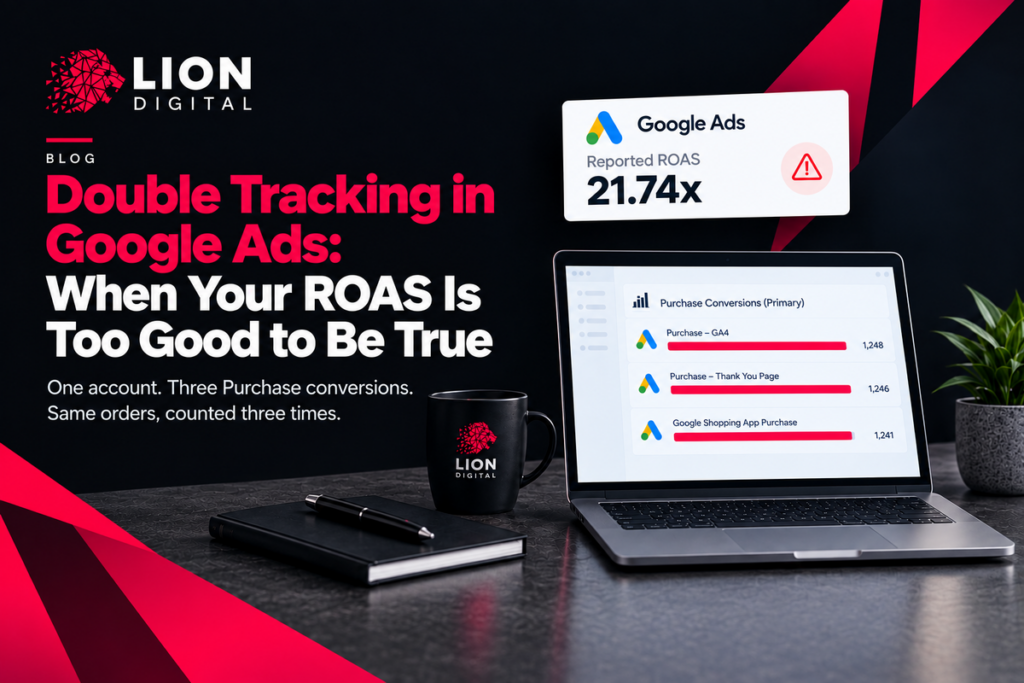
Note: This example is based on a real account audit, with figures adjusted to protect the client’s confidentiality. The relationships between the numbers (ROAS, conversion volumes) reflect what was actually found.
If your Google Ads account has ever looked almost too good to be true, you’re not alone.
A Google Ads account reporting a 21.74x ROAS looks like a dream. Until you audit the conversion tracking.
Consider an established Australian eCommerce Google Ads account that, on the surface, appeared to be performing exceptionally well. Between February and August 2025, the account spent approximately $62,326 and reported more than $1.35 million in conversion value.
The problem was that Google Ads wasn’t relying on one Purchase conversion action. It was relying on three.
All three were configured as Primary conversions. All three were included in the account’s conversion goals. And all three were passing purchase and revenue data back into Google Ads.
This wasn’t simply another case of Meta, Google Ads, GA4 and Shopify disagreeing over who should receive credit for a sale. This was a tracking implementation problem inside the Google Ads account itself.
And because the campaigns were using Target ROAS bidding, the issue affected more than reporting. The same potentially inflated conversion signals were also being used by Google to make automated bidding decisions.
Double Reporting and Double Tracking Are Not the Same Thing
Some disagreement between eCommerce platforms is expected. Google Ads, Meta, Klaviyo, GA4 and Shopify all measure customer journeys differently. They use different attribution windows, different attribution models, and different methods of connecting users across devices and sessions. As a result, the same order may legitimately appear as attributed revenue in multiple platforms. That is an attribution problem.
Double tracking is different. Double tracking occurs when multiple conversion actions inside the same advertising platform are recording overlapping versions of the same business outcome.
For example, an eCommerce business might have:
- A GA4 Purchase conversion imported into Google Ads
- A Purchase conversion firing from the order confirmation page
- A Purchase conversion created through the Google & YouTube or Google Shopping integration in Shopify
Each of those methods can have a legitimate purpose. The problem starts when several of them are simultaneously configured as Primary Purchase conversions and used together for bidding and reporting.
Google Ads can then treat multiple signals relating to the same underlying orders as separate conversion value. The dashboard looks stronger. The business itself hasn’t necessarily generated any additional revenue.
What We Found in an eCommerce Account Audit
During an audit of an Australian eCommerce account, we found three Purchase conversion actions simultaneously being used as Primary conversion goals – including a Google Shopping conversion tracking setup that was quietly duplicating revenue alongside GA4 and a legacy Thank You Page conversion:
- Purchase – GA4
- Purchase – Thank You Page
- Google Shopping App Purchase
All three were passing both conversions and conversion value.
Across February to August 2025, Google Ads reported:
Google Ads spend: $62,326.47
Purchase – GA4: 604 conversions, $577,380.63 conversion value
Purchase – Thank You Page: 1,039 conversions, $214,194.42 conversion value
Google Shopping App Purchase: 600 conversions, $563,095.14 conversion value
Combined, Google Ads reported 2,243 Purchase conversions and $1,354,670.19 in conversion value. Against $62,326.47 in advertising spend, the combined numbers produced an apparent 21.74x ROAS.
Taken at face value, the account looked extraordinarily efficient. But when we separated the conversion actions, a very different picture emerged.
Two Purchase Sources Were Reporting Almost Identical Results
The clearest signal came from comparing the GA4 Purchase action with the Google Shopping App Purchase action.
GA4 recorded 604 purchases worth $577,381 The Google Shopping App recorded 600 purchases worth $563,095 . That’s only four conversions apart, and their reported conversion values were within approximately 2.5% of each other.
Without transaction-level data, we wouldn’t claim that every individual order was duplicated one-for-one. But the similarity was significant. Two different Primary Purchase conversion actions were independently recording almost exactly the same volume and value over the same period, and Google Ads was counting both toward the account’s Primary conversion goals.
If you looked at the Google Shopping App Purchase action alone, the same advertising spend represented approximately 9.03x ROAS. Using the GA4 Purchase action alone: 9.26x ROAS. Compare those with the combined account result of 21.74x ROAS.
The combined conversion value was more than 2.3 times higher than either of the two closely aligned Purchase sources individually. That’s not a small reporting discrepancy. That’s enough to completely change how someone might assess the health and profitability of the account.
There Was Also a Legacy Thank You Page Conversion
The account contained a third Purchase action based on the Thank You Page. It recorded 1,039 conversions but only $214,194 in conversion value.
Its original setup and intended purpose could not be confirmed. The client did not know why it had originally been created, and because it was an inherited legacy conversion action, there wasn’t enough reliable documentation to reconstruct exactly how it was intended to work.
Rather than invent an explanation for the discrepancy, we treated it for what it was: an unverified legacy tracking implementation that should not continue influencing automated bidding.
The important finding wasn’t why that particular conversion behaved differently. It was that three separate Purchase actions were simultaneously being used as Primary conversion goals.
The Problem Had Been There for More Than a Year
Historical account data showed all three Purchase actions being used as Primary conversions from at least February 2025. Around August 2025, the Google Shopping App Purchase conversion was turned off, apparently around the same time the Google sales integration was disconnected from Shopify. That reduced the account from three Primary Purchase actions to two, but it didn’t solve the underlying problem – the GA4 Purchase and Thank You Page Purchase actions continued to be used as Primary conversion goals.
When we later inherited and audited the account, the duplicate setup remained. We can’t say why it was originally configured this way or whether previous account managers knowingly allowed it to remain. What we can say is that the configuration persisted for an extended period and materially affected the reported Google Ads performance.
That distinction matters. A tracking audit should establish what happened based on the account data. It shouldn’t speculate about intent where the evidence doesn’t support it.
Why This Matters More When You’re Using Target ROAS
Incorrect conversion tracking doesn’t only make reporting unreliable. It can change how Google Ads spends your money.
This account was using Target ROAS bidding, which uses the conversion values Google Ads receives to determine how aggressively it should bid in each auction. In simplified terms, Google is constantly asking: if I spend more here, how much conversion value am I likely to generate?
If the conversion value being fed back into Google Ads is inflated because several Primary Purchase actions are reporting overlapping revenue, the bidding algorithm is learning from a distorted version of reality. A campaign may appear capable of sustaining a much higher return than the underlying eCommerce performance actually supports.
That can influence bids, budget allocation, campaign scaling decisions, product prioritisation, performance forecasts, ROAS targets, and management reporting.
This is why conversion tracking should never be treated as a technical checkbox that only matters to analytics teams. It directly affects media buying.
How We Corrected the Account
Rather than trying to preserve the historical reporting structure, we rebuilt the Purchase tracking around one clearly defined Primary eCommerce conversion.
The Google sales integration in Shopify was properly set up and reconnected with Google’s platforms. The Google Shopping App Purchase conversion was then reactivated and selected as the main Primary Purchase action used for Google Ads optimisation. The other legacy Purchase actions were removed from Primary optimisation.
From that point forward, the account had one clearly defined Purchase signal feeding automated bidding rather than multiple overlapping Purchase actions competing for credit.
Reported performance declined after the correction. That was expected. A lower ROAS after fixing inflated tracking isn’t a deterioration in the business. It’s a more accurate measurement of the business.
More importantly, the corrected Google Ads numbers began aligning much more closely with the wider eCommerce data available through Shopify and GA4. The dashboard became less impressive. The data became more useful.
Why a Lower ROAS Can Sometimes Be Good News
Marketers naturally react negatively when ROAS drops. But a sudden decline following a tracking correction can actually represent an improvement in the quality of the account.
Imagine choosing between these two dashboards:
Account A — 21.7x reported ROAS, multiple overlapping Purchase conversions, unclear tracking ownership, and automated bidding optimising toward inflated signals.
Account B — approximately 9x platform ROAS, one clearly defined Primary Purchase conversion, clean conversion architecture, automated bidding optimising toward a trusted revenue signal.
The first number looks better. The second account is far more useful for making business decisions. Accurate measurement gives you a realistic baseline from which you can improve. Inflated measurement simply hides the work that needs to be done.
Signs Your Google Ads Account May Be Double Tracking Purchases
A conversion audit is worth prioritising if you see any of the following:
Multiple Primary Purchase conversions. Go into Google Ads and review your conversion goals. If GA4 Purchase, website Purchase, Shopify Purchase and another eCommerce Purchase action are all set as Primary, understand exactly why before assuming they should all remain active.
Conversion volume doesn’t reconcile with order volume. Google Ads attribution won’t perfectly match Shopify, but the numbers should still be explainable. If Google Ads appears to be recording dramatically more purchases than the business actually receives, investigate the conversion actions individually.
Several Purchase actions report very similar revenue. Two conversion actions independently reporting nearly identical purchase counts and revenue over long periods can indicate that they’re measuring substantially overlapping transactions.
ROAS looks unusually high. Exceptional performance is possible. But unusually high ROAS should still survive basic validation against revenue, order volume and individual conversion-action reporting. A strong number isn’t a reason to avoid auditing it. It’s a reason to understand where it came from.
Nobody knows why a conversion action exists. Legacy accounts often accumulate years of tracking changes. Agencies change. Developers change. Shopify integrations get replaced. GA4 gets implemented. GTM containers are rebuilt. If nobody can explain why a conversion action exists or what business decision it’s supposed to support, it shouldn’t automatically remain a Primary optimisation signal.
How eCommerce Brands Should Structure Purchase Tracking
There isn’t one universal setup that applies to every eCommerce business. What matters is having clear measurement governance.
For each Purchase conversion, document: where it originates, how it fires, what revenue value it passes, whether it is Primary or Secondary, which campaigns use it, whether it is used for automated bidding, and what role it serves alongside GA4 and Shopify.
Having multiple ways to measure purchases isn’t inherently bad. Secondary conversion actions can be useful for validation and troubleshooting. The danger comes from allowing several overlapping Purchase actions to simultaneously become Primary optimisation signals without understanding how they relate to one another.
Audit the Number Before You Optimise Toward It
Paid media teams spend enormous amounts of time adjusting budgets, ROAS targets, campaign structures, audiences, products and creative. But all of those optimisation decisions depend on one thing: the conversion data being correct. If the input is wrong, you can optimise an account perfectly and still end up moving in the wrong direction.
In this case, the eCommerce account didn’t need another bidding adjustment to explain its unusually strong historical ROAS. It needed someone to look underneath the headline number.
Three Primary Purchase conversions had become part of the account’s measurement architecture. Once they were separated and the account was rebuilt around one trusted Purchase signal, reported performance became lower but significantly more representative of the underlying eCommerce activity.
That’s the point of good tracking. Not to make the dashboard look better. To make the decisions made from it better.
Where LION Digital Fits
When LION takes over an established paid media account, we don’t assume the historical conversion data is correct simply because Google Ads has been reporting it for years. We audit the measurement setup alongside the campaigns themselves.
That means reviewing conversion actions, Primary and Secondary goals, Shopify and GA4 integrations, bidding signals, attribution settings and how reported platform revenue relates to what the business is actually seeing.
Sometimes the biggest opportunity isn’t another campaign. It’s discovering that the account you’ve been optimising isn’t measuring what everyone thought it was measuring.
If your Google Ads ROAS looks unusually strong, unusually weak or simply doesn’t reconcile with the rest of your eCommerce reporting, it’s worth investigating the conversion setup before making the next budget decision.
Get in touch with LION Digital for a conversion tracking audit. We’ll check whether your Google Ads account is measuring what you think it’s measuring – and fix it if it isn’t.
FAQs
1. Can Google Ads double count purchases?
Yes. If multiple Purchase conversion actions are configured as Primary and measure overlapping transactions, Google Ads reporting and automated bidding can incorporate more than one conversion signal relating to the same underlying purchase.
2. Should I only have one Purchase conversion in Google Ads?
Not necessarily. Multiple Purchase conversion actions can be useful for validation, troubleshooting and comparing tracking methods. The important distinction is which conversions are Primary and therefore used for bidding and headline reporting.
3. Why would GA4 Purchase and Shopify Purchase show slightly different numbers?
Different integrations can process attribution, consent, transaction data and event delivery differently. Small discrepancies do not automatically indicate broken tracking. The concern is when multiple substantially overlapping Purchase actions are all being treated as Primary conversions.
4. Can duplicate conversion tracking affect Target ROAS bidding?
Yes. Target ROAS relies on conversion value signals to inform bidding. If Primary conversion value is overstated, automated bidding can learn from a distorted performance signal.
5. Why did ROAS fall after fixing the tracking?
Because the corrected setup stopped combining multiple overlapping Purchase signals. A lower reported ROAS following a tracking correction does not necessarily mean campaign performance became worse; it may simply mean the account is now measuring performance more accurately.
6. How often should eCommerce conversion tracking be audited?
Tracking should be reviewed regularly and whenever there is a significant change to Shopify, GA4, Google Tag Manager, Google Ads conversion actions, consent management or eCommerce integrations. It should also be part of the onboarding process whenever a new agency or paid media team inherits an established account.